Every week I post a song, for no reason other than it's fabulous. It may be old or new, obscure or over-exposed. No explanation, no fancy spiel, just solid gold popular music. Oh, and it's a secret, so you'll just have to trust me.
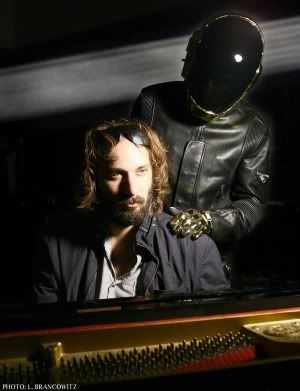
Firstly, he does guest vocals on the new Fatboy Slim project, the Brighton Port Authority. You can say what you want about Norman Cook, but you can't deny he knows his way around a pop tune, so the combination of the two of them, with Dizzee Rascal, is pretty irresistable. Nice cheeky video too.
Secondly, he has turned a building in New York into a giant musical instrument. Well, musical is debatable, but it seems pretty cool to me.
Here's a new feature at jamesinbrasil. Every week I will post a song, for no reason other than it's fabulous. It may be old or new, obscure or over-exposed. No explanation, no fancy spiel, just solid gold popular music. Oh, and it's a secret, so you'll just have to trust me. Solid Gold Popular Music Number One
I haven't had many musical epiphanies in my life (who has?), but one I clearly remember happened about 8 years ago. I was channel hopping in bed, trying to wake up, when I turned onto VH1 classics. They were showing Bo Diddley's Bo Diddley, a grainy performance from sixties TV. Something about it made me sit bolt upright in my bed, utterly captivated by the video. The primal backbeat, the egotastic simplicity of the lyric, Bo's shuffling dance, the bee-hived female backing vocals (which I'm always a sucker for), the screaming, white teenagers and sheer force of the song all compressed into a two minute alarm clock. I can't help but be jealous of everyone involved, existing at a time when music felt truly revolutionary, not just sonically, but socially.
Thanks to the joys of the modern world, I can now share this video with you. I hope you feel ten percent of the joy that I feel when I watch it:
The other day I was waiting for the bus when one drove by with the message "Nos vamos com O Senhor" (We go with God) on the front. Now this isn't entirely surprising in this country (home of the world's largest Catholic community), but it was on the electronic display where you would expect to see the destination. And I understand that Catholicism requires a leap of faith, but surely even the most ardent god-botherer would flinch at this. Do you trust the Lord to take you home, or do you wait for the next one? Guess what I did.
Man alive, do Brazilians love to get their Jesus on. And when you come from a largely secular country as I do, it can be a little disorienting to see such obvious shows of faith. 90% of the people I see reading in public are reading the Bible. It is very common to see people wearing t-shirts proclaiming their faith and devotion to the almighty. I also find it a little embarrassing, in my own English way, to see such a public display of emotion. Surely this is a private thing, to be respected, but kept to yourself? They parade it in the same way that I used to show off my taste in US indie bands when I sixteen: put it on your chest.
I guess this says more about me then it does about them, after all, why should they be ashamed and hide it away all anglo-saxon style? It's not exactly the Brazilian way. But just so you get an idea of how I feel, see below:
I kinda forgot about my Talking Heads round up, so let's bring it back and finish it off, starting here...
My favourite period of Talking Heads is the Stop Making Sense era. Not only is that my favourite of their albums, it's also one of the best films of all time. I must have seen it 12 times at least. So I guess it makes sense that the album recorded at that time is my favourite of all their studio albums. It's often overlooked, although for good reasons. It isn't produced by Brian Eno, it doesn't have Psycho Killer or Once In Lifetime on it and it was recorded in the eighties when everyone thinks of them as the quintessential New York seventies group. However it possesses possibly the finest opening quartet of songs in all of rock (Burning Down The House, Making Flippy Floppy, Girlfriend Is Better, Slippery People) and the finest song David Byrne ever wrote (This Must Be The Place (Naive Melody)). It a perfectly realised balance between pop, punk, funk and afrobeat, one which neither they or anyone else has bettered.
Here are my favourite tracks from February's blog pillage:
Sebastien Tellier's new album, Sexuality, is a splendid collection of breathy French housey pop, with production by Guy-Manuel de Homem-Christo of Daft Punk. It's not as full on as you would expect from that association, referencing more Daft Punk's love of 70's AM rock, as previously heard on Digital Love. It sounds like the kind of music that fellow Frenches Air and Phoenix attempted (and failed, in my humble opinion) to capture. Here's my favourite track, Divine, which reminds of a The The hit from the eighties which I can't remember the name of.
Free Blood features John Pugh, a former !!!-ster, and that's all I needed to know to investigate any further. They do not disappoint, as the video below shows:
Here's a track I shuffled across. I grabbed it a few of months ago, and should have put it up here before. I don't know anything about Findlay Brown, but the remix is by Beyond The Wizards Sleeve, who are Erol Alkan and Richard Norris, formerly of the Grid. This is the remix for people who don't like remixes, as BTWS gives the two DJ's the opportunity to showcase their love of psychedelia, Nuggets style garage rock, soundtracks and other oddities. It's one of the best remixes of the last year, and unlike anything else around. It also really reminds of something, but I can't figure out what. Any suggestions would be welcome.
And in other news, DFA records is the best. But they also don't like mp3 blogs very much, so you can go elsewhere to acquire the ace new LCD Soundsystem track, the tremendous new Juan Maclean single Happy House, and the fine new Hercules and Love Affair album.
For those of you who are Facebook inclined, I have set up a group for you to join if you wish. I'm not exactly sure why, possibly it's just to mention the group sleeveface, which is genius and provided me with astonishing image above.
March 7th is the day of the Marines, and of global prayer.
There used to be a really good second hand vinyl shop in Ruislip, north west London, called Sellanby (do you see what they did there?) that I frequented often, as it had loads of classic records for really good prices. I distinctly remember returning home from one successful trip with three records, Devo's Are We Not Men? We Are Devo, David Bowie's Heroes and Talking Heads Fear Of Music. It was only when I was pouring over the sleeves that I realised that the all three of these records were produced by Brian Eno. In my early to mid-twenties, when I really did my homework and discovered the music that I love the most, he was always there, at every turn. Glam rock, check, punk rock, check, new wave, check, experimental music, check, krautrock, check...
The thing with writing about Brian Eno is that it's really daunting. His discography is so vast and all-encompassing, it's impossible to know where to begin. Do I talk about his rock albums, ambient works, Roxy Music albums (they were never the same after he left), production, or even his installations, motivational speeches, journalism, political roles or 'obliquestrategies.'
I think it's best to leave all that aside, and let you investigate for yourself, if you haven't already. Suffice it to say, I know that my taste in music would be much poorer if it wasn't for him.
Sâo Paulo, Rio De Janeiro, Salvador...they sound so exotic and tropical to us non-Brazilians. But as soon as you have a basic grasp of the Portuguese language, then you realise that actually these names are really mundane and boring. So here's my guide to boring Brazilian place names:
Sâo Paulo - St. Paul Rio De Janeiro - January River Salvador - Saviour Santos - Saints Recife - Reef Belo Horizonte - Nice horizon Rio Preto - Black river Rio Branco - White river Ouro Preto - Black gold Natal - Christmas Fortaleza - Fort Porto Alegre - Happy port Campo Grande - Big field Boa Vista - Good view Sâo José Do Rio Preto - St. Jose of the black river Brasília - Britain-chester
So what do we learn from this? Well not a lot, obviously. Just because January River is such a tedious name doesn't stop Rio from being lovely. I suppose it does show us that the Portuguese settlers were very unimaginative folks, and that, despite it's faults, Woodingdean is a very exotically named place to have grown up.
Tom Zé comes onto the stage dressed as a record player. On his arm he has an oversized stylus, and various wires are sprouting from his back and shoulders. There is a 12" disc pressed up against his belly. Looking at a 72 year old man dressed as a record player filled me with a joy I have rarely experienced, This is mainly because I haven't looked at many men dressed as record players in my life, especially septuagenarian ones, but I also haven't looked at many geniuses either, and here I am, killing two birds with one stone.
"I don't make art, I make spoken and sung journalism."
Tom Zé is more famous in Brazil then he should be. He is too old, his music is too odd and he doesn't sound like this. But everyone has heard of him, and I even saw him giving a guide to tai chi on breakfast tv.
"I discovered at a young age that I was horrible composer, a horrible instrumentalist, and a horrible singer."
Tom Zé first released a record in 1968 at the age of 32. He was a key player in the tropicalia movement of the late sixties, but kept a distance from the group as he was ten years older then them. He eventually slipped into obscurity, and was rediscovered by David Byrne (it's that man again), who released a best of on Luaka Bop. Here is his seminal, victorious performance at Tropicalia's defining moment, 1968's Festival da Cançao:
Tom Zé is funny. Live, he tells jokes, some of which even I can understand. He talks frankly about himself, sex and politics, and praises the young people of Brasília, as they can live in amongst all this corruption and remain dignified and decent. One of my favourite songs when I saw him live was all about himself. In the first verse tells us that his cd's are very reasonably priced, that we should buy them as they are very good, and that he doesn't understand why he isn't more popular. In the second, he adopts the critics voice to say "who the hell does this Tom Zé think he is? He's too old, he's no good etc." Meanwhile, his band sing a chorus of his name, repeated for comedy effect.
Tom Zé is the best example that I can think of an artist who has remained vital, challenging and interesting into his later years.
"Songs are inside of me, like pearls resting in oysters"
Tom Zé is (cliché alert) a true original, not in the way that some people are because they wear brightly coloured clothes, but because you know his brain is wired in a different way to other people. He makes these sounds because in his head he hears poetry and truth, and if it sounds disorienting and odd to you, well, that's your problem. He reminds me of Bjork (or should that be the other way round?), as he successfully marries experimental sounds with pop, in his case the Brazilian genres of forro, pagode and samba with electronics, odd lyrics and humour. He also has a eye for the visual (e.g dressing as a record player), and the importance of 'performing' on stage, as opposed to merely 'appearing'. He is uniquely Brazilian, but is completely out of place in the popular culture of the country.
Tom Zé was going to manage a petrol station when he met David Byrne.
The first in an occasional series of not entirely serious reflections on Brazilian life as seen through the eyes of an outsider. There are around 20 public holidays a year in Brazil, which is about three to four weeks off a year, (if it falls on a weekend, it isn't moved). Sounds great doesn't it? The only problem is that I am in one of those jobs where if I don't work, I don't get paid, so they can be a bit of a pain to me as I am always having to reschedule everything to fit in.
But more interesting than this are the commemorative days which generally celebrate saints and professions. Today is the day of the printers and 15th of October is teachers day, for example. Fair enough you think, but some of these days are mental, for example, 9th of June is the day of the doormen, tennis players and people who make prosthetic limbs. 5th of October is the day of the trees. I am not making this up.
I'm not sure what we citizens of Brazil are supposed to do on these days. Maybe we should just lean back and reflect on all the good work that the trees do for us, and consider a life without prosthetic limbs. Makes you think doesn't it?




 Posts
Posts


